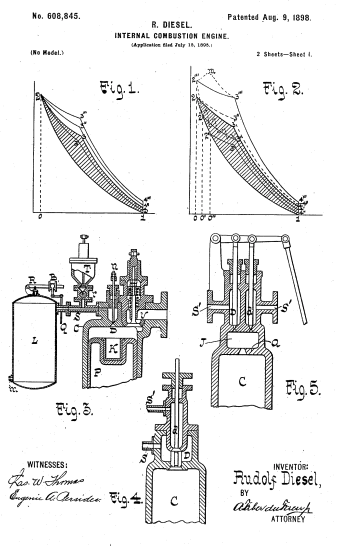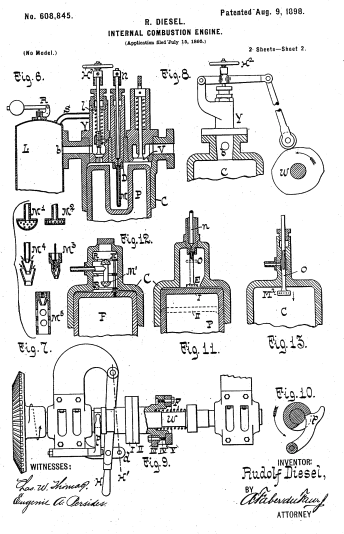

On August 9, 1898, an invention that would reshape transportation, industry, and the global energy landscape received official recognition in the United States. That day, the U.S. Patent Office issued U.S. Patent No. 608,845 to German engineer Rudolf Diesel for his work on a “liquid-fuel engine” — a milestone in the development of the engine that would later bear his name.
More than a century later, Diesel’s invention remains one of the most influential engineering achievements of the modern era.
During the late 19th century, engineers were searching for more efficient alternatives to steam engines and early gasoline engines. Rudolf Diesel, born in Paris in 1858 and educated in Germany, believed that existing engines wasted too much energy. His goal was ambitious: create an internal combustion engine that could achieve far greater efficiency by compressing air to a high pressure and temperature before introducing fuel.
Unlike gasoline engines, which rely on a spark to ignite a fuel-air mixture, Diesel’s concept used the heat generated by compression itself to ignite the fuel. This approach allowed engines to extract more useful work from each unit of fuel.
U.S. Patent No. 608,845 represented a key moment in Diesel’s efforts to protect and promote his engine concept. The patent described improvements related to the operation of a compression-ignition engine using liquid fuel.
The technology behind Diesel’s engine was not immediately perfected. Early prototypes faced enormous engineering challenges, including problems with fuel injection, materials, manufacturing precision, and reliability. Through continued experimentation and refinement, the diesel engine became a practical and powerful technology.
The impact of Diesel’s invention spread rapidly. Diesel engines became essential in applications where efficiency, durability, and high torque were critical, such as ships, rail locomotives, heavy trucks and construction equipment, and power generation.
Today, diesel technology continues to evolve. Modern diesel engines incorporate advanced fuel injection systems, computer controls, turbocharging, emissions-reduction technologies, and alternative fuels. While the environmental challenges associated with diesel emissions have led to major innovation and debate, the fundamental engineering principles introduced by Diesel remain important.
A patent issued more than a century ago was not just a document of invention — it was a blueprint for a technological revolution.